

How Much Does a Small Business Website Cost in the UK? 2026 Guide
Small business website cost UK estimates can vary significantly depending on the type of website you need, its features, and who you hire. This 2026 guide explains what UK small businesses can expect to pay for DIY, freelancer and professional agency websites.
If you are planning a new website for your business, one of the first questions is likely to be:
How much should a small business website actually cost?
Unfortunately, searching for an answer often creates more confusion.
One web designer might quote £700. Another might quote £3,000. An agency could propose £8,000 or considerably more — and all three may describe the project as a “small business website”.
The reason is simple: you are not really buying a number of pages. You are paying for a combination of strategy, design, development, content, functionality, SEO preparation, testing and support.
For a small business website in the UK, current 2026 market pricing ranges from inexpensive DIY website-builder subscriptions to professional projects costing several thousand pounds.
Several current UK pricing studies and industry guides place many professionally built small-business websites somewhere around £1,500 to £6,000, although more complex projects can easily move beyond that range.
That does not mean £1,500 is automatically cheap, £6,000 is automatically expensive, or that every business should spend somewhere between the two.
The useful question is:
What should your business receive for the money?
This guide explains what different budgets normally buy, what increases the cost of a website and what you should check before accepting a web design quote.
Small Business Website Cost UK: A Quick 2026 Breakdown
There is no official UK tariff for web design, so the figures below should be treated as market ranges rather than fixed industry prices.
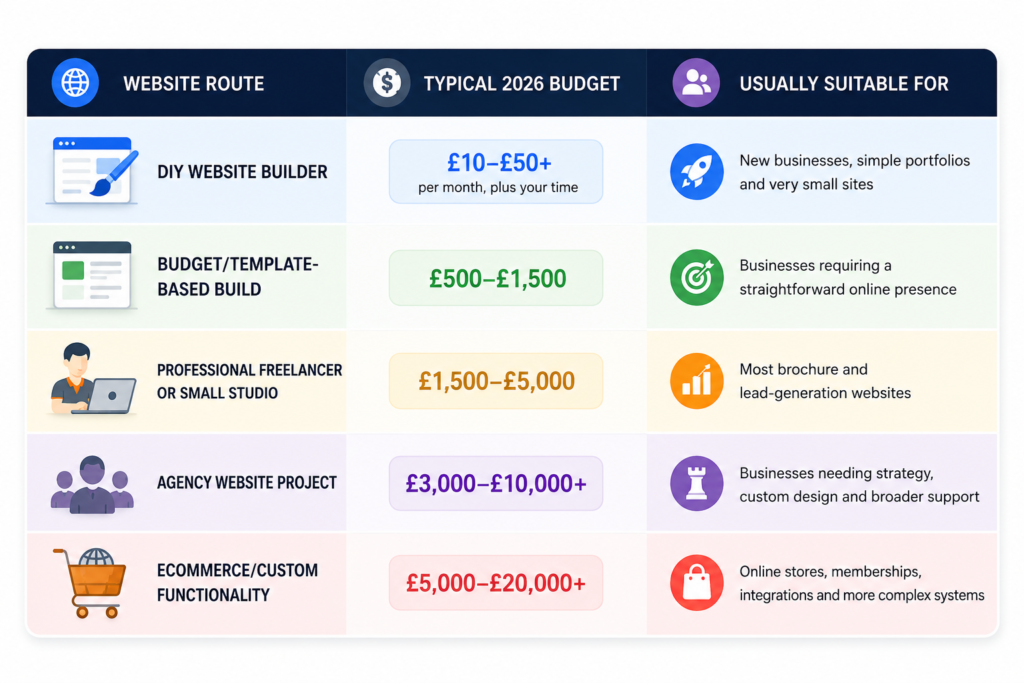
Current UK sources differ on the exact boundaries but consistently show the same overall pattern: DIY is the cheapest route, freelancer and studio projects generally occupy the middle of the market, and strategy-led agency or bespoke projects cost substantially more.
The size of the quote is therefore only meaningful when you know what is included.
Why Does Website Design Cost Vary So Much?
Imagine two businesses both asking for a five-page website.
The first business needs:
- Home
- About
- Three service pages
- Contact form
- Existing logo
- Existing photography
- Existing written content
The second business also says it needs a five-page website, but requires:
- Brand and competitor research
- New page structure
- Custom UX design
- Professional copy
- Conversion-focused landing pages
- Local SEO setup
- Online booking
- CRM integration
- Analytics configuration
- Migration from an existing website
- Redirects from old URLs
- Staff training after launch
Both projects may technically have five pages.
They are not remotely the same amount of work.
That is why comparing website quotes only by page count can be misleading.
1. DIY Website Builders: The Lowest Upfront Cost
Platforms such as Wix and Squarespace allow business owners to build websites themselves using templates and visual editors.
This can be a sensible option when:
- your budget is extremely limited
- your requirements are simple
- you are testing a new business idea
- you enjoy working with website tools
- you have enough time to design and populate the website properly
The subscription itself may look inexpensive.
The cost that is often ignored is your time.
A website still needs structure, written content, images, mobile optimisation, forms, calls to action, basic SEO and testing. A website builder makes the technical construction easier, but it does not automatically make those business decisions for you.
DIY is therefore not necessarily a bad option.
It is simply a different trade-off: you save professional fees by doing more of the work yourself.
2. Freelancer Website Costs
A professional freelancer can be an excellent option for small businesses with relatively straightforward requirements.
Freelancers usually have lower overheads than larger agencies, which can make their pricing more accessible.
For a brochure-style small business website, you may see freelancer pricing starting below £1,000 and extending into several thousand pounds depending on experience and scope.
The important question is not simply whether the person is a freelancer.
Find out what they actually provide.
For example:
- Is the design customised?
- Is mobile optimisation included?
- Will they help structure the pages?
- Is copywriting included?
- Is basic on-page SEO included?
- Are forms tested?
- Is analytics setup included?
- Will redirects be handled if replacing an existing site?
- Is training provided?
- What happens after launch?
Two freelancers charging £1,500 may be offering completely different levels of service.
3. Web Design Agency Costs
An agency will normally cost more than a solo freelancer because a project may involve several disciplines.
Depending on the agency, that could include:
- project management
- UX planning
- web design
- development
- copywriting
- SEO
- quality assurance
- analytics
- integrations
- ongoing support
Current 2026 UK pricing guides show agency websites beginning in the low thousands and moving to £10,000 or substantially higher as scope increases.
Paying an agency does not automatically guarantee a better website.
Likewise, paying a freelancer does not automatically mean accepting lower quality.
What matters is whether the provider has the right capability for your project and whether the proposal clearly explains what you are purchasing.
How Much Does a Five-Page Website Cost in the UK?
“Five-page website cost” is a common search because small businesses often imagine a typical structure such as:
- Home
- About
- Services
- Testimonials or Projects
- Contact
For a straightforward professionally built site, roughly £1,000–£5,000 is a useful initial planning range, based on the broader freelancer and studio pricing visible across the current UK market.
But five pages alone tell us very little.
A five-page website using supplied copy, existing branding and a well-established template will cost much less than five strategically planned pages requiring custom design, original copywriting, SEO research and integrations.
Ask what each page is expected to achieve rather than simply asking how many pages are included.
What Actually Increases the Cost of a Business Website?
Several factors have a much greater effect on website development cost than page count alone.
Custom Design
Using an existing framework or template normally requires less design time.
Creating a tailored visual system, unique layouts, custom interactions and responsive behaviour requires more work.
That does not mean every small business needs a fully bespoke design.
The correct level of customisation should depend on your brand, customers and business objectives.
Copywriting
Who is writing the content?
If you provide polished, final copy, the developer can concentrate on the website itself.
If the provider needs to research your services, establish messaging, organise your value proposition and write every page, the scope increases considerably.
Good website copy is not simply filling empty boxes with words.
It should help visitors understand:
- what you do
- who you help
- why they should trust you
- what they should do next
SEO Preparation
Basic technical setup and full SEO strategy are not the same service.
A website may need:
- keyword research
- URL planning
- title and meta optimisation
- internal-link planning
- local targeting
- redirect mapping
- structured data
- technical SEO checks
- Google Search Console setup
If organic search matters to your business, find out exactly what “SEO included” means before comparing quotes.
Ecommerce
An ecommerce website introduces considerably more complexity than a standard brochure website.
You may need:
- product templates
- product variants
- categories
- payment processing
- tax configuration
- shipping rules
- customer accounts
- transactional emails
- order management
- analytics
- inventory integrations
This is why comparing the price of a Shopify or WooCommerce store with a simple service-business website is rarely useful.
Booking Systems
A basic enquiry form is relatively straightforward.
A booking system may need calendars, staff availability, payment collection, automated reminders or connections to third-party software.
Each requirement adds planning, configuration and testing.
Website Integrations
Modern business websites increasingly connect with other systems.
Examples include:
- CRM platforms
- email marketing software
- accounting systems
- appointment tools
- payment platforms
- property databases
- automation tools
- external APIs
These integrations can save considerable administrative time, but they also increase development and testing requirements.
Existing Website Migration
Replacing an established website can require more work than starting from scratch.
The development team may need to preserve:
- important URLs
- existing rankings
- analytics
- tracking codes
- blog content
- images
- metadata
- form functionality
Incorrect migration can create unnecessary SEO and user-experience problems.
What Costs Are Often Missing From a Website Quote?
The build price is only one part of the cost of owning a website.
Before approving a project, check whether the following are included.
Domain Name
Your domain is the address people use to reach your website.
Renewal costs vary depending on the domain extension and registrar.
Ideally, your business should retain control of its domain account rather than relying entirely on a third party.
Hosting
WordPress itself is open-source software and can be used without software licensing fees, but a WordPress website still needs hosting and usually requires additional services around it. WordPress itself confirms that its software is open source and can be used commercially without licensing fees.
Hosting prices vary according to performance, traffic, support and infrastructure.
Premium Themes, Plugins or Apps
Some functionality requires paid third-party software.
Examples can include:
- advanced forms
- booking tools
- premium ecommerce extensions
- security services
- page-building tools
- membership systems
Ask whether licences are included in your quote and who pays the renewals.
Website Maintenance
Launching a website does not mean it will never need attention again.
Depending on the platform, ongoing work may include:
- software updates
- backups
- security checks
- content changes
- uptime monitoring
- performance optimisation
- plugin troubleshooting
Maintenance will be covered in detail in another guide in this series, but it should still be considered when calculating your overall website budget.
VAT
Always check whether a quoted price includes VAT.
The standard UK VAT rate is currently 20% for most goods and services, although whether VAT is charged depends on the supplier and circumstances.
A quote of £5,000 excluding VAT can therefore produce a very different final invoice from a £5,000 VAT-inclusive proposal.
Is a Cheap Website a Bad Idea?
Not automatically.
A £600 website can be completely appropriate for a new sole trader who needs a simple online presence.
A £10,000 website could be unnecessary for the same business.
The problem starts when the cheapest option cannot support what the business actually needs.
For example, saving money may prove expensive if the website:
- is difficult to use on mobile
- loads slowly
- cannot be edited easily
- generates no enquiries
- has weak service pages
- has no proper tracking
- needs to be rebuilt shortly afterwards
- damages existing search visibility during migration
Equally, there is no reason to buy functionality simply because an agency can provide it.
The goal is not to purchase the cheapest website or the most expensive website.
It is to purchase the appropriate website for the business.
When Is It Worth Spending More?
A larger investment becomes easier to justify when the website has a bigger commercial role.
For example, consider investing more when the website needs to:
- generate a significant share of new enquiries
- support paid advertising campaigns
- rank competitively in search
- sell products online
- automate lead handling
- integrate with your CRM
- process appointments
- support several locations
- replace an outdated website without losing SEO visibility
- represent a high-value professional service
A website for a business obtaining most of its work through referrals has a different commercial requirement from a website expected to generate 30 new enquiries every month.
The budget should reflect the role the website needs to play.
How to Compare Website Quotes Properly
Instead of comparing only the final number, create a simple checklist.
Ask whether the quote includes:
- discovery and planning
- sitemap or page planning
- design
- development
- mobile optimisation
- content upload
- copywriting
- basic SEO setup
- analytics
- contact forms
- spam protection
- redirects
- testing
- hosting
- software licences
- maintenance
- staff training
- post-launch support
You should also ask:
Who owns the website?
Clarify ownership of:
- domain
- website files
- design assets
- hosting account
- administrator access
Can the website grow?
A small initial website may later require:
- additional services
- landing pages
- ecommerce
- bookings
- CRM integration
- multilingual content
- automation
Ask whether the platform and structure can accommodate that growth.
What happens after launch?
Find out whether support is included and what future work costs.
A low initial quote can become considerably more expensive if every small change requires additional fees.
How Much Should Your Small Business Budget?
For many UK small businesses looking for a professionally built brochure or lead-generation website in 2026, £1,500–£6,000 is a reasonable starting range for budget discussions, based on the ranges repeatedly appearing in current UK market research.
However, your project may reasonably sit below or above that range.
A simpler website with supplied content and limited functionality might cost less.
A project requiring strategy, custom design, SEO, ecommerce, integrations or substantial content work can cost significantly more.
Before deciding what to spend, define what the website needs to accomplish.
For example:
“We need a five-page website.”
is much less useful than:
“We need a website that clearly presents our three services, builds credibility with homeowners in our service area and encourages visitors to request quotations.”
The second brief gives a designer something meaningful to solve.
Final Thoughts: Focus on Value, Not Just the Build Price
The cost of a small business website in the UK can range from a modest DIY subscription to many thousands of pounds.
That wide range exists because websites do very different jobs.
A simple digital brochure is not the same project as a lead-generation website with SEO strategy, custom functionality, ecommerce or business automation.
Before comparing prices, decide:
- what the website needs to achieve
- what functionality you require
- who will provide the content
- whether organic search matters
- what systems need to be connected
- what support you need after launch
Then compare quotes based on the outcome and scope — not simply the headline figure.
If you are planning a new website and are unsure what level of development your business actually needs, Genius Globe Tech can help you assess the project before you commit to unnecessary features or the wrong platform.
Request a Free Quote or discuss your website project with Genius Globe Tech.
FAQ
A professionally built basic small-business website may cost anywhere from around £1,000 to several thousand pounds depending on design, content, SEO requirements and functionality. DIY and template-based options can cost considerably less.
A simple five-page website might cost around £1,000–£5,000 as a broad planning range, but page count alone is not enough to price a project accurately. Custom design, copywriting, SEO, integrations and migration work can change the cost significantly.
Different providers include different levels of strategy, design, development, content, SEO, testing and ongoing support. Two quotes describing the same number of pages can therefore represent very different projects.
The WordPress software itself is open source and can be used without a commercial software licence. However, businesses still need to budget for items such as hosting, domains, development and potentially premium plugins or maintenance.
It depends on your project. A skilled freelancer may be ideal for a straightforward business website, while an agency can be useful when a project requires multiple disciplines such as strategy, design, development, SEO, content and integrations.
Payment structures vary. Some providers request a deposit before work starts and further payments at agreed milestones. Others use monthly or subscription models. Make sure payment terms, deliverables and ownership are clearly documented before work begins.
Sometimes. Basic on-page setup may be included in website development, while keyword research, content strategy, local SEO and ongoing optimisation are normally separate services. Always ask what “SEO included” actually covers.
SometiSometimes, but not always. Check whether hosting, backups, security, software updates and technical support are part of the quote or charged separately.es. Basic on-page setup may be included in website development, while keyword research, content strategy, local SEO and ongoing optimisation are normally separate services. Always ask what “SEO included” actually covers.