

Small Business Website Cost USA: How Much Should You Expect to Pay?
small business website cost USA is one of the most common searches from business owners planning a new website in 2026. The final price can vary significantly depending on the type of website, required features, and whether you choose a DIY builder, freelancer, or professional web design agency.
If you are planning a new website for your business, one of the first questions you will probably ask is:
How much is this actually going to cost?
Search online and you will find wildly different answers.
One developer may offer a website for $800. A freelancer may quote $3,000. A web design agency may propose $10,000 or $20,000 for what initially sounds like the same project.
That does not necessarily mean one provider is overcharging and another is offering a bargain.
The phrase “small business website” covers a huge range of projects.
A five-page informational site for a local contractor is very different from a website that needs appointment scheduling, payment processing, custom copywriting, local SEO, CRM integrations and automated lead follow-up.
For a professionally developed small business website in the USA, a useful 2026 planning range is roughly $1,500 to $10,000+ for many service-business and marketing websites.
That is a planning range rather than an official national average. Current US pricing sources differ significantly: Forbes Advisor lists professional design from around $1,500 upward, while recent 2026 market guides commonly show professional small-business projects beginning around $1,500 and moving into five figures as strategy and functionality increase.
The better question is not simply:
“How much does a website cost?”
It is:
“What does my business actually need the website to do?”
This guide explains what different budgets can buy, what increases website development costs, which expenses are easy to overlook and how to compare web design quotes without choosing based on price alone.
There is no regulated or standardized website-development price in the United States.
Treat the following figures as planning ranges, not fixed pricing.
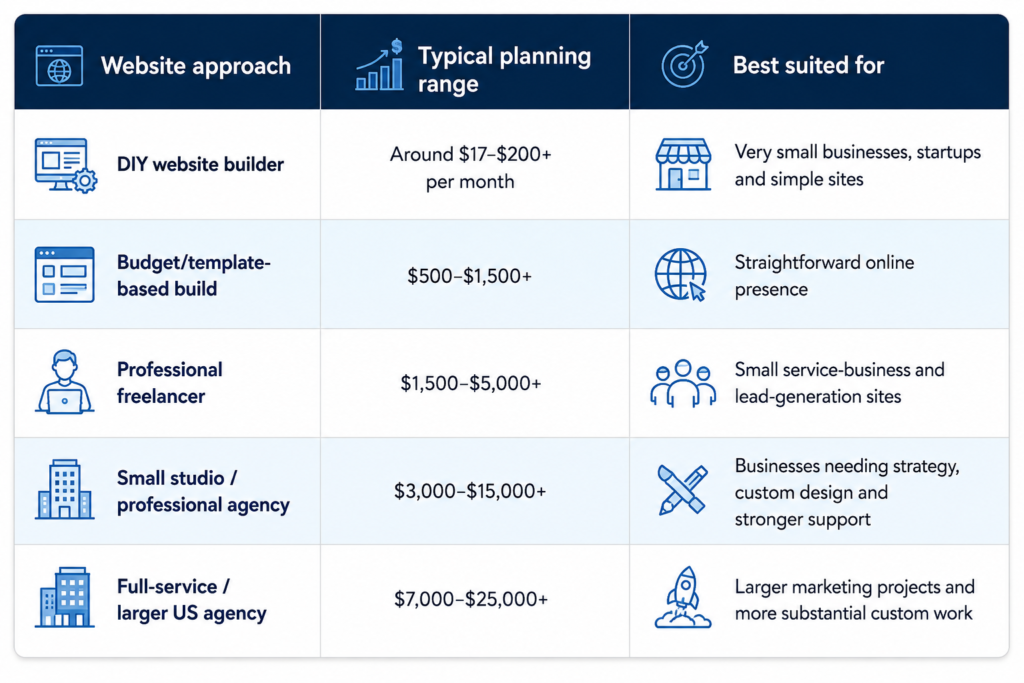
Current pricing sources support the overall pattern rather than one precise number. A recent five-page pricing analysis places freelancer projects at roughly $1,500–$5,000 and studios/agencies at around $3,000–$15,000+, while broader US agency benchmarks can start around $7,000 and extend dramatically higher for customized projects. That is why two quotes should never be compared based only on the total price. You need to understand the scope behind each number.
Why Can Two Websites Cost Completely Different Amounts?
Consider two plumbing companies.
Both say:
“We need a five-page website.”
The first company already has:
- professional branding
- final website copy
- photography
- a clear service structure
- one simple contact form
Its website may only require design, development, mobile optimization and basic technical setup.
The second company needs:
- competitor research
- keyword research
- new website copy
- individual service pages
- location targeting
- custom graphics
- online appointment requests
- CRM integration
- automated lead notifications
- Google Analytics setup
- an SEO migration from an old site
Technically, both businesses could still call the project a “small business website.”
The workload is completely different.
This is why page count is useful for estimating scope, but it should never be the only factor used to price a website.
Option 1: Building the Website Yourself
DIY website builders have made it much easier to launch a website without hiring a developer.
Platforms such as Wix and Squarespace provide templates, hosting and visual editors within a monthly subscription.
As of August 2026, Wix’s published business-site plans are roughly $17 for its entry-level paid plan and increase through higher tiers as ecommerce, storage and business functionality expand. Wix also notes that actual pricing can vary depending on plan and location.
DIY can make sense when:
- you are starting with a very small budget
- your website is simple
- you already understand your messaging
- you are comfortable working with design tools
- your time is less expensive than hiring someone
The important word is time.
The software may be inexpensive, but you still need to decide:
- what pages to create
- what those pages should say
- how visitors should navigate
- where calls to action belong
- what the mobile experience should look like
- how forms should work
- how basic SEO should be configured
- what analytics should be installed
A website builder reduces the technical barrier.
It does not automatically create a strong business strategy.
Option 2: Hiring a Freelance Website Designer or Developer
Freelancers cover a very wide market.
You may find someone charging a few hundred dollars for a template setup or an experienced developer charging several thousand dollars for a strategic custom project.
For a professionally delivered small-business site, roughly $1,500–$5,000+ is a useful starting range for many freelancer projects based on current 2026 market comparisons.
Freelancers can be an excellent fit when your project:
- has a clear scope
- does not need a large multidisciplinary team
- needs direct communication with the person building the site
- has a realistic budget
- needs customization without full-service agency overhead
However, “freelancer” describes a working arrangement — not a quality level.
One freelancer may only design websites.
Another may handle development, SEO, content, hosting and automation.
Before comparing prices, compare capabilities.
Option 3: Hiring a Web Design Agency
Agency pricing tends to rise because the project may involve several specialists rather than one person.
Depending on the agency and project, that can include:
- discovery and strategy
- UX planning
- visual design
- development
- copywriting
- SEO
- project management
- testing
- analytics
- integrations
- ongoing support
Current US agency pricing varies enormously.
DesignRush’s 2026 agency pricing benchmark says US agency projects can begin around $7,000 for smaller projects and go well beyond $100,000 for larger custom work. That does not mean a small business needs a $100,000 website; it demonstrates how broad the term “agency website project” can be.
Smaller studios and remote agencies can sit below traditional full-service US agency pricing because their overhead and team structures are different.
Again, compare what you receive rather than the business label attached to the provider.
How Much Does a 5-Page Website Cost in the USA?
A five-page site is one of the most common starting points for small businesses.
A typical structure might include:
- Home
- About
- Services
- Reviews, Projects or FAQ
- Contact
For a professionally built five-page site, around $1,500–$5,000 is a reasonable initial planning range for many freelancer and small-studio projects, while custom agency work can go significantly higher.
A recently published 2026 analysis specifically addressing five-page business sites reports freelancer pricing of roughly $1,500–$5,000 and agency/studio pricing from around $3,000–$15,000+.
But a five-page website can still cost substantially more if those pages require:
- original copywriting
- custom illustrations
- advanced animation
- SEO research
- custom forms
- appointment booking
- third-party integrations
- multilingual content
- database functionality
Do not ask only:
“How many pages do I get?”
Also ask:
“What work goes into each page?”
What Actually Determines Website Development Cost?
1. Strategy and Planning
A website can be built from a list of pages, or it can be planned around customer journeys and business goals.
Strategic projects may involve:
- competitor research
- target customer analysis
- conversion planning
- website architecture
- keyword research
- content planning
That work takes time before development even begins.
2. Template vs Custom Design
Using an existing template is generally faster.
Custom layouts require more design and development time because the website is being shaped around your specific content, branding and user journey.
You do not necessarily need custom everything.
A good provider should customize where it creates meaningful business value rather than adding complexity for its own sake.
3. Website Copy
Content is one of the biggest underestimated parts of a website project.
Someone needs to explain:
- what your business does
- who you serve
- what makes your service relevant
- how your process works
- why a visitor should trust you
- what they should do next
If you already have strong final copy, development is easier.
If the project includes research, positioning and conversion copywriting, the cost rises accordingly.
4. Search Engine Optimization
A website can look excellent and still be poorly prepared for organic search.
SEO preparation may involve:
- keyword research
- search-intent analysis
- URL structure
- service-page planning
- title tags
- meta descriptions
- heading hierarchy
- internal linking
- image optimization
- technical SEO
- redirects
- structured data
- Google Search Console
There is also a significant difference between SEO foundations at launch and an ongoing SEO campaign.
When a quote says “SEO included,” ask what that actually means.
Google itself recommends creating helpful, reliable, people-first content rather than producing pages primarily to manipulate search rankings.
5. Mobile Experience and Performance
Responsive design should not be treated as an optional extra in 2026.
Customers may visit your website from:
- smartphones
- tablets
- laptops
- large desktop displays
The website needs to remain usable across those devices.
Performance also requires real technical work.
Google’s current Core Web Vitals guidance focuses on loading performance, responsiveness and visual stability through LCP, INP and CLS.
A provider spending time optimizing images, scripts, hosting configuration and layout behavior is doing more than simply making a page “look good.”
6. Ecommerce
A small ecommerce website involves much more than adding a shopping-cart button.
Projects can require:
- product templates
- inventory
- variants
- shipping
- taxes
- payment gateways
- promotional codes
- order emails
- customer accounts
- analytics
- return policies
- integrations
That is why ecommerce projects normally require a different budget from standard service-business websites.
We will cover Shopify and WooCommerce pricing separately later in this series.
7. Booking and Scheduling
Businesses such as consultants, salons, clinics, instructors and service companies may need customers to schedule appointments online.
Booking functionality can involve:
- calendars
- staff schedules
- service duration
- payment collection
- confirmations
- reminders
- cancellation rules
- external calendar integrations
The more business logic involved, the more configuration and testing are required.
8. CRM and Business Integrations
A modern website does not always operate by itself.
Your contact forms may need to connect with:
- HubSpot
- Salesforce
- email platforms
- appointment systems
- Google Sheets
- accounting software
- payment platforms
- automation systems such as n8n
- internal databases
For example, instead of simply emailing a new inquiry, a workflow could:
Website form → CRM → sales notification → follow-up email → task creation
That can reduce manual administration, but integration work increases project scope.
Hidden Website Costs Small Businesses Should Budget For
The build quote is rarely the only website expense.
Domain Name
Your domain needs to be registered and renewed.
Pricing depends on the extension and registrar.
Where possible, the business owner should retain access and ownership of the domain account.
Hosting
Self-hosted systems such as WordPress require hosting.
Hosting costs vary according to:
- traffic
- performance
- support
- security
- backups
- server resources
WordPress itself is open-source software and can be used and modified commercially without paying WordPress software licensing fees.
That does not mean a WordPress website is completely free — development, hosting, plugins and maintenance can still cost money.
Plugins, Apps and Software
A website may use paid tools for:
- forms
- ecommerce
- booking
- security
- backups
- analytics
- memberships
- automation
Check whether annual renewals are included.
Photography and Graphics
Good imagery can significantly affect how professional a website feels.
Costs may include:
- professional photography
- stock photos
- custom illustrations
- icon design
- product photography
Maintenance
Websites require ongoing attention.
That can include:
- backups
- software updates
- security monitoring
- content updates
- performance checks
- troubleshooting
Forbes Advisor also separates the initial website build from ongoing expenses such as hosting, apps and maintenance when estimating total ownership costs.
Cheap Website vs Expensive Website: Which Is Better?
Neither automatically wins.
A $750 website may be a smart purchase for a new solo business with extremely simple requirements.
A $15,000 site might make sense for an established company where the website supports large contracts and substantial lead generation.
The problem is not buying a cheap website.
The problem is buying a website that is too limited for the job you expect it to perform.
Likewise, paying more does not guarantee better results.
A provider should be able to explain why each major part of the project exists.
If you do not need:
- custom animations
- complex integrations
- twenty landing pages
- an advanced booking system
then you should not pay for them simply because they can be built.
When Is a Larger Website Budget Worth It?
Spending more becomes easier to justify when the website has a direct role in generating revenue.
For example, if your website needs to:
- generate new sales leads
- support Google Ads campaigns
- rank for competitive services
- handle online bookings
- sell products
- serve multiple locations
- integrate with your sales process
- automate follow-ups
- replace an established site without losing important SEO value
then the project deserves more planning than a simple online brochure.
Think about the commercial role of the site.
A consultant selling $5,000 engagements may only need one extra qualified inquiry for a website improvement to matter financially.
A local restaurant may evaluate its website differently.
Website value always depends on the business model.
Do You Need to Hire a Web Designer in Your Own US City?
Not necessarily.
Many website projects can be managed completely remotely.
Your developer does not need to be located in New York because your business is in New York, or in Austin because your business is in Austin.
Location matters less when the provider has a reliable process for:
- video meetings
- project communication
- feedback
- file sharing
- contracts and scope
- website handover
- support after launch
If you work with a remote provider, ask about communication hours and response expectations before starting.
The advantage is that you can evaluate providers based on skills, fit and scope rather than ZIP code alone.
The disadvantage is that poor remote communication can become frustrating quickly.
Make communication expectations part of your buying decision.
How to Compare Website Quotes Properly
Suppose you receive:
Quote A: $2,500
and
Quote B: $5,000
It is tempting to assume Quote A is half the price.
But first compare whether each includes:
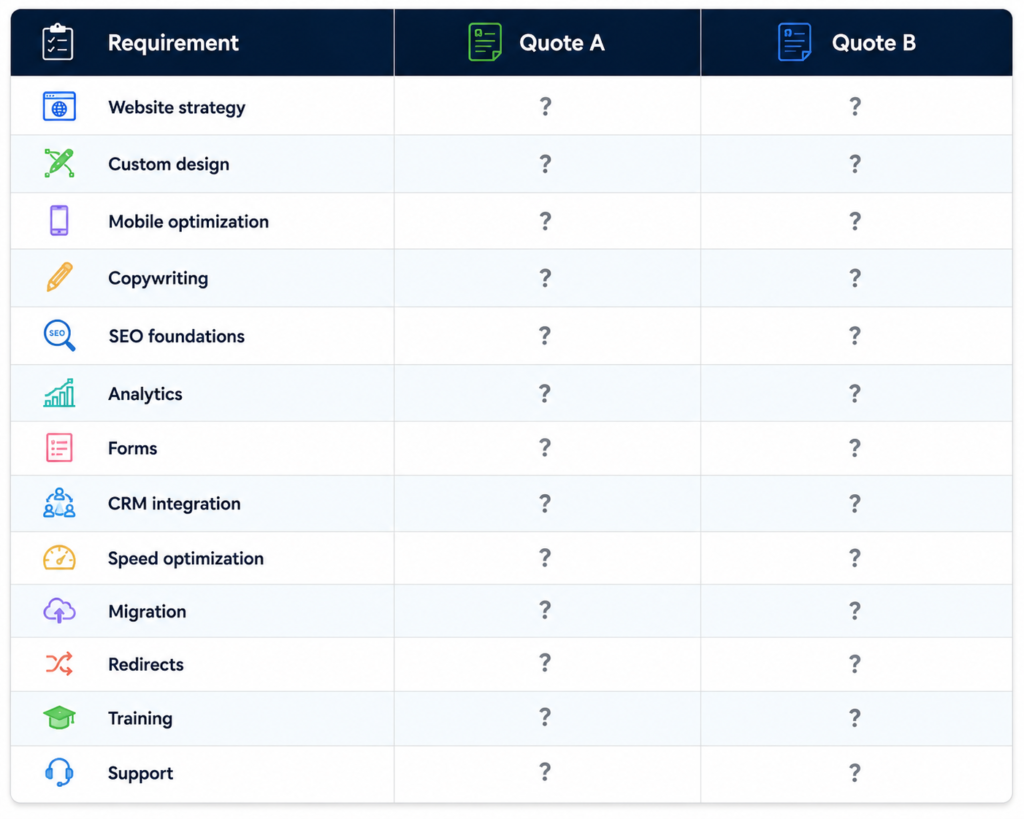
Only after filling in that table do the prices become genuinely comparable.
Ask Who Owns the Website
Confirm ownership and access to:
- domain
- hosting
- CMS
- website administrator account
- source files where applicable
- analytics accounts
- Search Console
- design assets
You do not want to discover after launch that critical accounts are controlled entirely by the provider.
Ask About Revisions
Clarify:
- how many design revisions are included
- what counts as a revision
- how scope changes are handled
- what additional work costs
Ask What Happens After Launch
Find out whether:
- bugs are covered
- training is included
- backups are configured
- maintenance is available
- future changes are hourly or fixed-price
These questions often reveal more about a proposal than the total price.
How Much Should a US Small Business Budget?
For many US service businesses needing a professional marketing or lead-generation website, I would treat $1,500–$10,000+ as a useful initial conversation range, not a fixed rule.
Current sources demonstrate why a single average is misleading. Forbes starts professional website design around $1,500, while several current 2026 US market guides place typical professional projects anywhere from the low thousands into $10,000–$15,000 depending on provider and scope.
You may reasonably spend less if:
- the site is simple
- you supply finished content
- a template is appropriate
- no complex integrations are needed
You may spend much more if:
- you need custom UX
- substantial content is required
- SEO is a major acquisition channel
- you have many services or locations
- you need ecommerce
- you need software integrations
- you need custom functionality
Start by defining what success means.
Instead of saying:
“We need a five-page website.”
try:
“We need a website that explains our services clearly, builds trust with local customers and consistently turns visitors into quote requests.”
That gives your developer a real business problem to solve.
FAQ
Many professional small-business websites fall somewhere around $1,500–$10,000+, although simpler sites can cost less and custom agency projects can cost considerably more.
For many professionally built five-page business websites, approximately $1,500–$5,000 is a useful planning range for freelancer and small-studio work. Custom agency projects can cost more.
Yes. DIY website builders and low-cost template services can keep the initial expense below $1,000. The tradeoff is usually more owner involvement, less strategy, less customization or a narrower scope.
Rates vary substantially by experience and business model. Some freelancers charge by the hour, while others use fixed project prices. Agencies typically charge more because projects involve additional specialists and overhead.
The WordPress software itself is open source and does not charge a commercial licensing fee. Hosting, development, premium plugins and maintenance may still create ongoing costs.
Usually in direct cash cost, yes — particularly when you build the site yourself. Wix currently offers paid website plans beginning around the high teens per month, while professional design and development normally costs substantially more.
Basic SEO foundations may be included, but an ongoing SEO strategy is usually a separate service. Ask exactly what the provider means by “SEO included.”
Sometimes. Never assume they are. Ask specifically about hosting, backups, software updates, security and post-launch support.
Not necessarily. Most modern website projects can be delivered remotely. Evaluate communication, portfolio quality, process, capability and support rather than location alone.
There is no fixed expiration date. A well-maintained website can remain useful for years, but changes in branding, customer expectations, technology and business strategy may eventually justify a redesign.
Final Thoughts: Buy the Website Your Business Actually Needs
There is no single correct small business website cost in the USA.
A website may cost a few hundred dollars when much of the work is DIY, several thousand dollars for professional development, or tens of thousands for a larger custom project.
The price matters.
But scope matters more.
Before choosing a provider, determine:
- what you want the website to accomplish
- what pages you genuinely need
- who will create the content
- whether organic search matters
- what functionality is required
- what systems need to connect
- what support you expect after launch
Then compare providers based on what they actually propose to build.
Planning a New Website for Your Business?
If you are unsure whether your business needs a straightforward brochure website, WordPress development, Wix Studio, ecommerce functionality or custom integrations, Genius Globe Tech can help you scope the project before development begins.
We can work with businesses remotely, so your choice of developer does not have to be limited to your own city.