
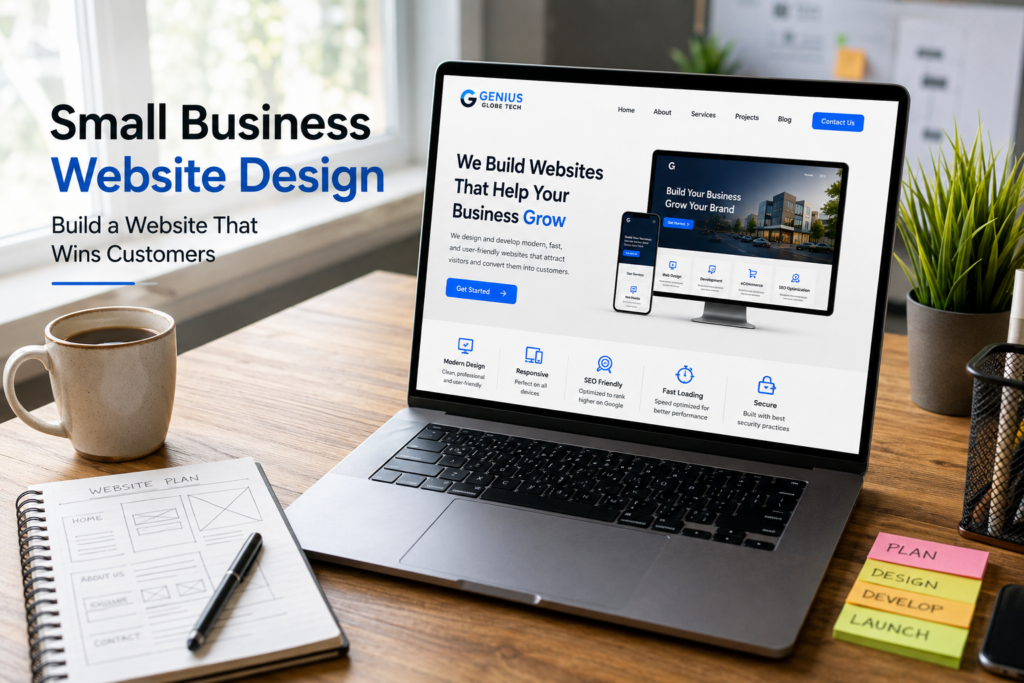
Small Business Website Design: How to Build a Website That Wins Customers
Your website is often the first real interaction a potential customer has with your business.
Before someone calls, sends an enquiry, books a consultation or decides to work with you, they may visit your website to understand who you are, what you offer and whether your business can be trusted.
That is why small business website design should be about much more than creating an attractive homepage.
A successful business website needs to communicate clearly, work perfectly on mobile devices, load quickly, build trust and guide visitors towards taking the next step.
Whether you are running a local service business, startup, professional company or growing brand, your website should work as an important part of your business rather than simply existing online.
In this guide, we explore what makes a professional small business website effective and what businesses should consider when planning a new website or redesigning an existing one.
Customers have more choices than ever before.
When someone discovers your business through Google, social media, a directory or a recommendation, one of the first things they may do is search for your website.
If they find a professional, clear and trustworthy website, it immediately gives them more confidence in your company.
If they find an outdated, confusing or poorly designed website, they may leave and choose a competitor instead.
A strong business website can help you:
- Present your services professionally
- Build trust with potential customers
- Generate enquiries and leads
- Explain what makes your business different
- Make it easier for customers to contact you
- Improve your visibility in search engines
- Support your marketing campaigns
- Showcase previous work and testimonials
- Create a stronger brand presence
For many small businesses, the website becomes the central point connecting Google, social media, email marketing, paid advertising and customer enquiries.
Start With Your Business Goals
A successful small business website design project should always begin with clear business goals.
Before thinking about colours, layouts or animations, start with one important question:
What should your website actually achieve?
Different businesses need websites for different reasons.
A local service business may want more phone calls and quotation requests.
A consultancy may want visitors to schedule consultations.
An ecommerce business needs customers to browse products and complete purchases.
A property company may need visitors to explore listings and submit enquiries.
A healthcare or wellness business may need customers to understand services and book appointments.
When your website goals are clear, the entire structure becomes easier to plan.
Every page, button and call to action should support a real business objective.
Modern small business website design must provide a smooth experience across mobile phones, tablets, laptops and desktop computers.
Your potential customers may discover your business while browsing on a smartphone, checking Google, scrolling through social media or opening a link from an email.
That means your website cannot simply look good on a desktop screen.
A professional responsive website should adapt smoothly to different screen sizes.
Buttons should be easy to tap, text should remain readable, images should resize correctly and contact forms should be simple to complete.
Navigation should also remain clear and easy to use.
If visitors have to zoom, scroll sideways or struggle to find important information, they are more likely to leave.
A strong mobile experience is now an essential part of professional website development.
Keep Your Website Message Clear
One of the biggest mistakes businesses make is trying to say too much at once.
When someone arrives on your homepage, they should quickly understand:
Who are you?
What do you offer?
Who do you help?
Why should they choose you?
What should they do next?
Your homepage headline should clearly communicate your main service or value.
Instead of using vague statements such as:
“Welcome to our website”
or
“We provide innovative solutions”
use messaging that actually explains the business.
For example:
Professional Website Development for Growing Businesses
This immediately gives the visitor context.
Clear communication is one of the most important parts of effective professional website design.
Speed should be considered from the beginning of every small business website design project.
Visitors expect websites to load quickly, and a slow website can create frustration before someone even has the chance to learn about your business.
Large images, unnecessary plugins, poorly optimised code and excessive visual effects can all affect website performance.
Professional website development should therefore focus on both appearance and speed.
This can include:
- Optimised images
- Reliable hosting
- Efficient website structure
- Proper caching
- Reduced unnecessary scripts
- Clean page layouts
- Performance-focused development
The goal is not simply to create a website that looks impressive.
It should also feel fast, responsive and effortless to use.
Trust is one of the most important elements of effective small business website design.
People are less likely to contact a business if the website does not feel professional, current or trustworthy.
Your website should answer the questions potential customers may have before they decide to contact you.
Useful trust elements include:
Real Testimonials
Customer feedback helps new visitors understand what working with your business is actually like.
Previous Projects
A portfolio or case study section demonstrates real experience and gives potential customers confidence in your work.
Clear Contact Information
Visitors should be able to quickly find your email address, contact form or other preferred ways to reach your business.
About Your Business
People often want to understand who is behind the company and what experience the team has.
Professional Branding
Consistent colours, typography, imagery and messaging help your business appear more professional and established.
Privacy and Business Information
Professional businesses should also include appropriate privacy, cookie and legal information where required.
Trust is not created by one section alone. It is built through the entire website experience.
Do not make visitors search through paragraphs of text to discover what your company actually offers.
Create clear service pages.
For example, a digital agency may have separate pages for:
- Website Development
- Ecommerce Development
- SEO
- Social Media Marketing
- Graphic Design
- Automation Solutions
Individual service pages are useful for both customers and search engines.
Visitors get detailed information about exactly what they need, while search engines have a clearer understanding of what each page is about.
This is particularly important for businesses trying to attract customers through organic search.
Create Clear Calls to Action
Every important page should guide the visitor towards a next step.
Common calls to action include:
- Request a Quote
- Book a Consultation
- Discuss Your Project
- Contact Our Team
- Get Started
- View Our Work
- Send an Enquiry
A call to action should stand out visually without becoming intrusive.
It should also appear naturally throughout the page.
Someone who has just read about your services should not have to scroll back to the top of the website to contact you.
Good small business website design removes unnecessary friction between interest and action.
A common small business website mistake is putting every service on a single page.
A better structure is usually:
Homepage
About
Services
- Service One
- Service Two
- Service Three
Projects or Case Studies
Blog
Contact
Dedicated service pages allow you to provide more detailed information and target more relevant search phrases.
For example, someone searching for WordPress website development has a different need from someone searching for Shopify website development.
Providing dedicated content helps you communicate directly to each audience.
A project gallery is useful.
A case study is even better.
Instead of showing only a screenshot, explain the project.
A strong case study can include:
- Client industry
- Business challenge
- Website requirements
- Platform used
- Features developed
- Design approach
- Integrations
- Project outcome
Potential customers want to know whether you have solved problems similar to theirs.
Case studies provide evidence of your experience while giving search engines more useful information about the types of projects your company handles.
Search engine optimisation should not be something added only after a website is completed.
The website should have a strong SEO foundation during development.
Important elements include:
Clear Page Structure
Each page should focus on a specific topic or service.
Proper Heading Structure
Pages should use logical H1, H2 and H3 headings.
SEO Titles and Meta Descriptions
Each important page should have unique metadata.
Internal Linking
Related pages should link naturally to one another.
Image Optimisation
Images should use appropriate file sizes and descriptive alternative text.
Mobile Responsiveness
The website should work correctly across devices.
Fast Performance
Pages should load efficiently.
Helpful Content
Your website should answer real questions potential customers are searching for.
An SEO-friendly website design creates a stronger foundation for long-term organic visibility.
There is no single platform that is perfect for every business.
The right choice depends on what your website needs to achieve.
WordPress
WordPress can be an excellent choice for service businesses, corporate websites, content-heavy websites, custom websites and businesses that want significant flexibility.
Wix
Wix can work well for businesses that want an easy-to-manage website with a modern visual editing environment.
Shopify
Shopify is designed specifically for ecommerce and can be a strong option for businesses focused on selling products online.
The important part is choosing the platform based on your business needs rather than simply choosing the most popular option.
An experienced website development agency should be able to recommend the right solution based on your goals.
Your Website Should Support Lead Generation
Good small business website design should guide visitors towards enquiries, bookings or other meaningful actions.
A business website should never leave potential customers wondering what they should do next.
The customer journey should be simple:
Visitor discovers your website → understands your service → sees evidence of your work → gains trust → contacts your business.
Useful lead-generation features may include:
- Contact forms
- Consultation booking
- Quote request forms
- Click-to-call buttons
- Clear email links
- Service-specific enquiry forms
- Strong calls to action
The easier it is for a qualified visitor to contact your business, the more effectively your website can support your sales and marketing efforts.
Your website should not only attract visitors. It should help turn the right visitors into real business opportunities.
Avoid Overcomplicated Website Design
Modern website design does not mean filling every section with animations, sliders and effects.
Sometimes simpler is better.
A professional website should use visual elements where they improve communication.
Too many effects can:
- Distract visitors
- Slow down the website
- Make navigation confusing
- Reduce readability
- Hide important information
A clean website with strong typography, professional imagery, clear sections and strategic calls to action is often more effective than an overly complicated design.
Keep Your Website Updated
Launching a website should not be the final step.
Businesses change.
Services change.
Team members change.
Projects are completed.
New customer questions appear.
Your website should evolve with the business.
Regularly review:
- Service information
- Contact information
- Testimonials
- Project portfolio
- Website security
- Plugins and software
- Blog content
- Broken links
- Forms
- Mobile usability
Keeping your website current demonstrates that your business is active and professional.
You may not always need a completely new website.
However, a redesign may be worth considering if your existing website:
- Looks outdated
- Is difficult to use on mobile
- Loads slowly
- Does not generate enquiries
- No longer represents your services
- Has confusing navigation
- Is difficult for your team to update
- Does not support SEO properly
- Does not reflect your current branding
A website redesign should solve business and user-experience problems rather than simply changing colours and images.
Choosing the Right Website Development Agency
The right development partner should understand both technology and business.
Before selecting a small business web design agency, review:
- Previous projects
- Technical expertise
- Design quality
- Communication
- Development process
- Support options
- Platform experience
- Client feedback
- Understanding of your industry
Most importantly, choose a team that asks questions about your business rather than immediately talking only about design.
The website should be built around your customers and goals.
How Genius Globe Tech Helps Businesses Build Better Websites
At Genius Globe Tech, we design and develop professional websites for businesses that want a stronger online presence and a website built around real business goals.
Our website development services include solutions using platforms such as WordPress, Wix and Shopify, along with website redesign, ecommerce development and custom website functionality.
We focus on creating websites that are:
- Modern and professional
- Mobile responsive
- Easy to navigate
- SEO-friendly
- Performance focused
- Built around clear business goals
- Designed to encourage enquiries
Every business is different, which is why we begin by understanding the company, customers, services and objectives before planning the website.
Whether you are launching a new business, replacing an outdated website or improving an existing online presence, the goal should always be the same:
Build a website that supports your business.
Final Thoughts
Successful small business website design combines strategy, usability, professional development, SEO and clear communication.
A professional business website is more than a digital brochure.
It can become one of the most valuable tools your business has for building trust, explaining your services, attracting potential customers and generating new opportunities.
Focus on creating a website that answers your customers’ questions, demonstrates your expertise and makes it easy for people to take the next step.
Your website should work smoothly across devices, load quickly, communicate clearly and support your wider business goals.
When all of these elements work together, your website becomes more than something people simply visit.
It becomes an important part of how your business grows.
Ready to Improve Your Business Website?
If you are planning a new website or thinking about redesigning your existing one, Genius Globe Tech can help you create a modern, responsive and professional website built around your business goals.
Explore our website development services, view our recent projects or contact our team to discuss your next website project.
Build a stronger online presence with Genius Globe Tech.
FAQ
A good small business website should clearly explain what the business offers, work properly on mobile devices, load quickly, build trust and make it easy for potential customers to contact the business.
Responsive design allows a website to adapt to smartphones, tablets and desktop screens. This creates a better experience for visitors regardless of the device they use.
Both platforms can work well depending on the business requirements. WordPress offers significant flexibility and customisation, while Wix provides an accessible visual website-building environment. The best platform depends on the website’s goals and required functionality.
SEO helps search engines understand your website and can improve its ability to appear for relevant searches. Technical structure, page content, speed, mobile usability and useful information all contribute to a stronger SEO foundation.
Clear services, strong calls to action, trust signals, case studies, simple contact forms and an easy customer journey can help turn more website visitors into enquiries.
Yes. Existing websites can often be redesigned to improve appearance, mobile usability, performance, navigation, SEO structure and lead generation without changing the entire business identity.